아카데미 기사
Unit Price Analysis: Five to Sevenfold Value from the Same Cotton
T
저자: TRTex Editorial Team
게시일: 2026년 8월 12일 · 최종 검토: 2026년 9월 28일 · ⏱️ 2 분 읽기
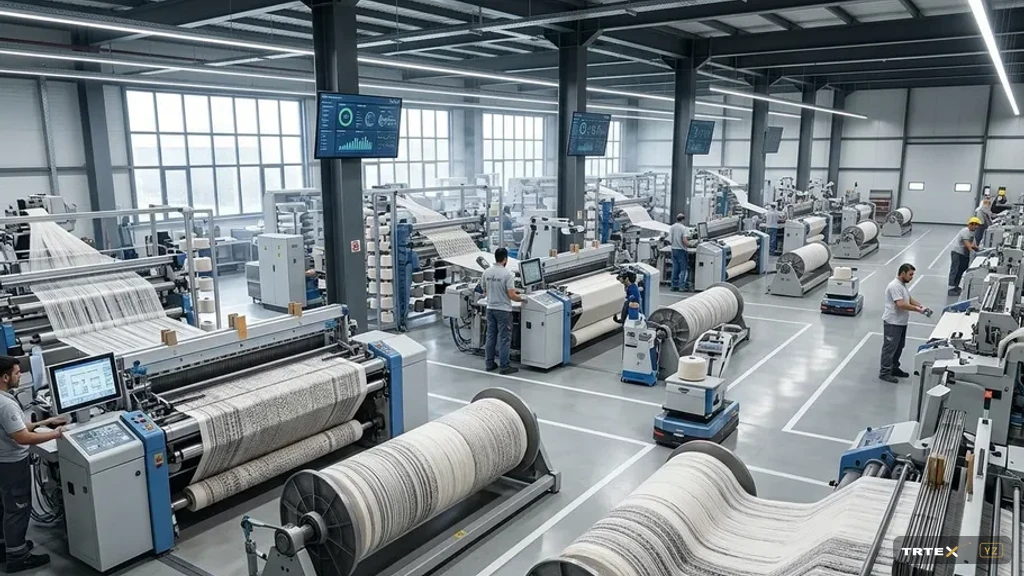
Unit Export Values Across Raw Materials and Finished Goods
Export unit prices across the home textiles and apparel sectors demonstrate pronounced variations depending on manufacturing depth and added value [1, 6]. According to United Nations Statistics Division (UN Comtrade) data, Turkey exported raw cotton in 2025 at an average unit value of 1.84 dollars per kilogram [6]. In contrast, when that same cotton fiber is transformed into finished home textile products, export unit values reach 9.50 dollars per kilogram for cotton towels, approximately 10.9 dollars for cotton bed linen, and 14.0 dollars for cotton bathrobes [6]. These figures demonstrate that processing the identical raw fiber through spinning, weaving, dyeing, finishing, and confection delivers a 5 to 7.6-fold increase in added value per kilogram [6].
Official regional export metrics reinforce this value-added progression [1]. Data published by the Denizli Exporters Association (DENİB) indicate that while Turkey's nationwide export unit value averaged 1.60 dollars, Denizli's overall export unit value achieved 2.48 dollars [1]. Evaluated by individual product categories, export unit values in Denizli rise to 9.85 dollars for towels, 10.47 dollars for bed linen, and 15.65 dollars for bathrobes [1].
Global Cotton Price Benchmarks and Market Dynamics
Raw material costs across international cotton markets are monitored through recognized global commodity indices [3, 4]. The primary international benchmark for conventional cotton is the Cotlook A Index compiled by Cotton Outlook [3]. This index is calculated by taking the average of the five cheapest quotations among representative upland cottons traded internationally [3].
According to World Bank commodity market data (Pink Sheet), the Cotlook A Index registered at 2.03 dollars per kilogram in May 2026, before declining to 1.90 dollars per kilogram in June 2026 [4]. This 6.4% month-on-month decrease reflects cyclical price fluctuations inherent to global agricultural commodities [4].
Organic and Chemical Safety Certification
For products carrying organic or chemical safety assertions, documentation by independent certification bodies is essential [2, 5]. In organic cotton textiles, the Global Organic Textile Standard (GOTS) establishes globally recognized certification benchmarks for goods manufactured from organic fibers [2]. GOTS mandates independent third-party audits of all facilities across the supply chain from fiber preparation to final distribution [2].
Simultaneously, consumer safety requirements demand the OEKO-TEX Standard 100 label [5]. This label verifies that the textile article has been tested for harmful substances [5].
T
TRTex Editorial Team
AI 지원으로 작성 · TRTex AI
이 콘텐츠는 AI 지원으로 작성되었습니다(EU 인공지능법 2024/1689, 제50조). 출처가 있는 정보는 해당 출처 링크와 함께 제공합니다. 잘못되었거나 누락된 정보를 발견하시면 문의 페이지를 통해 알려 주십시오.
출처 및 인용
- DENİB — Denizli İhracatçılar Birliği (접속일: 2026-09-28) — denib.gov.tr ↗
- Global Standards gGmbH (GOTS) (접속일: 2026-09-28) — global-standards.org ↗
- Cotton Outlook (Cotlook, endeksin sahibi) (접속일: 2026-09-28) — cotlook.com ↗
- Dünya Bankası (Pink Sheet, Temmuz 2026) (접속일: 2026-09-28) — thedocs.worldbank.org ↗
- OEKO-TEX (접속일: 2026-09-28) — oeko-tex.com ↗
- UN Comtrade (BM İstatistik Bölümü) — Türkiye 2025 ihracatı, HS 630260 satırı (접속일: 2026-09-28) — comtradeapi.un.org ↗