AKADEMİ MAKALESİ
GRS Certification & Recycled Textile Standards Guide
T
Yazar: TRTex Editorial Team
Yayınlanma: 24 Haziran 2026 · Son Gözden Geçirme: 24 Haziran 2026 · ⏱️ 4 dk okuma
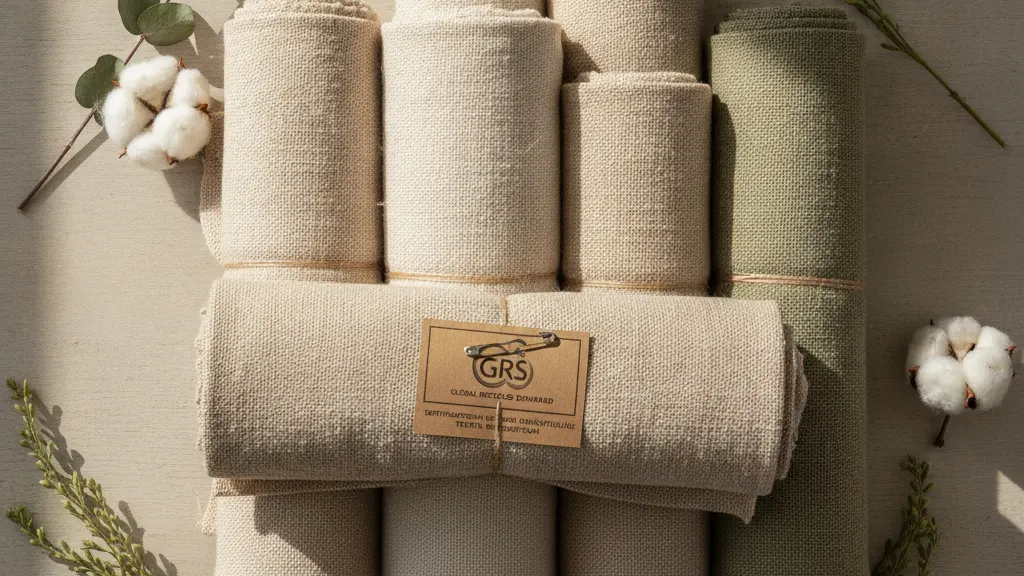
Guide to GRS Certification and Recycled Textile Standards
The Global Recycled Standard (GRS) is an international, voluntary, full product standard that sets requirements for third-party certification of recycled content, chain of custody, social and environmental practices, and chemical restrictions. Within the sustainability framework of B2B home textile and apparel procurement tenders, possessing active GRS certification and verified Transaction Certificates (TCs) has become an essential prerequisite, particularly for fabrics incorporating recycled polyester and recycled cotton.
Fundamental Comparison Between GRS and RCS Standards
| Evaluation Criteria | GRS (Global Recycled Standard) | RCS (Recycled Claim Standard) |
| :--- | :--- | :--- |
| Minimum Recycled Content | 20% (At least 50% required for consumer logo use) | 5% (RCS Blended) or 95% (RCS 100) |
| Chain of Custody | Mandatory (Tracked via Transaction Certificates - TC) | Mandatory (Tracked via Transaction Certificates - TC) |
| Environmental Criteria | Mandatory (Auditing wastewater, water, and energy use) | Exempt (Solely monitors raw material inputs) |
| Social Responsibility Criteria | Mandatory (Adherence to ILO conventions, worker rights) | Exempt (Solely monitors raw material inputs) |
| Chemical Restrictions | Mandatory (REACH compliance, toxic substance bans) | Exempt (Solely monitors raw material inputs) |
[Source: Textile Exchange GRS Certification Guide, 2026-03] In GRS certification, issuing an official Transaction Certificate (TC) to accompany every commercial shipment at each tier of the supply chain is legally mandatory for full traceability.
> Editor Analysis:
> *In European B2B tenders (such as public sector uniforms or municipal hotel and hospital linen contracts), a simple self-declaration stating that 'recycled yarn has been used' is strictly unacceptable. Tender specifications mandate that all upstream and downstream manufacturers throughout the supply chain leading to the finished product hold active GRS Scope Certificates and validate every lot with Transaction Certificates (TCs). Furthermore, to apply the official GRS logo on finished product packaging or care labels, the proportion of recycled material in the final article must be at least 50%.*
Frequently Asked Questions
Question 1: What is a Transaction Certificate (TC) and when must it be issued?
Answer 1: A Transaction Certificate (TC) is an official traceability document issued by an accredited certifier for every shipment of raw materials or semi-finished goods from a GRS-certified seller to a buyer, certifying authentic recycled content. The application to the certification body must be completed within 6 months from the date of the commercial sales invoice and shipping bill.
Question 2: My textile contains 30% recycled polyester. Can it receive GRS certification?
Answer 2: Yes. The GRS standard permits certification for any textile product containing at least 20% recycled content. However, to display the official GRS consumer logo on packaging and retail labels, the recycled threshold must reach at least 50%.
Question 3: How long is a GRS Scope Certificate valid?
Answer 3: A GRS facility Scope Certificate (SC) is valid for exactly 1 year (12 months) from its date of issuance and must be renewed annually through on-site factory audits.
Question 4: What is the primary operational difference between RCS and GRS?
Answer 4: RCS solely verifies the physical presence and percentage of recycled raw material. GRS additionally evaluates fair labor standards, factory environmental management (wastewater and energy efficiency), and toxic chemical restrictions. Consequently, GRS carries significantly higher prestige and mandatory compliance status in global B2B tenders.
Question 5: Are polyester yarns produced from post-consumer recycled PET bottles covered by GRS?
Answer 5: Yes. Polyester yarns and fabrics extruded from post-consumer recycled plastic bottles represent the single largest and most common application domain for GRS certification.
Question 6: Are laundering care instructions standardized for GRS certified textiles?
Answer 6: Laundering instructions depend on the specific fiber composition (cotton, polyester, linen); however, GRS certification indirectly incentivizes appropriate care protocols that maximize product longevity and preserve fiber resilience.
Knowledge → Revenue Bridge: Active Tender Opportunities
Active commercial B2B tenders specifying certified recycled and sustainable textiles:
* [B2B Tenders Requiring GRS and Recycled Content Certification](/ihaleler?q=GRS+recycled)
T
TRTex Otomasyon
Bağımsız Editöryal Gözetim ve Doğrulama
Bu içerik, TRTex.com araştırma ve editöryal süreçlerinden geçerek yayınlanmıştır. B2B sektörel dürüstlük prensipleri uyarınca kişisel görüşler ve ticari kaygılardan bağımsız hazırlanır.
KAYNAKLAR & ATIFLAR
- Textile Exchange (Yayın Tarihi: 2026-02-15) — Textile Exchange GRS Standard Guide rules ↗