Where Does Turkish Textile Stand Amid the Ascendance of Vietnam and India?
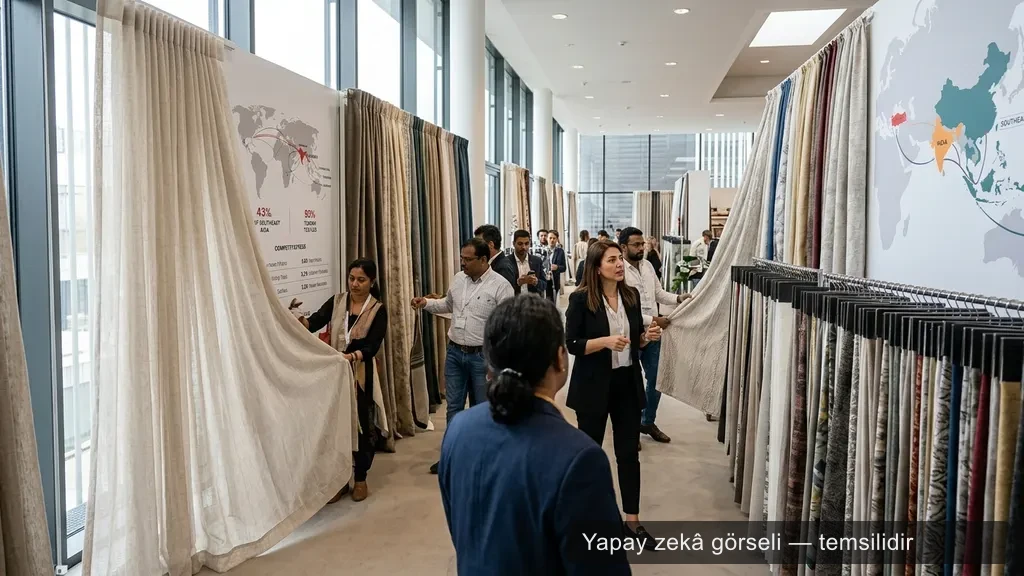
As Vietnam and India expand their presence across global textile markets, this analysis evaluates Turkey's export positioning and competitive strategies, emphasizing the primacy of technical value-add over price wars.
The global textile industry is undergoing a period of structural transformation, characterized prominently by the expanding production capacities and export volumes of Southeast and South Asian nations. The sustained ascendance of competitors such as Vietnam and India is establishing a challenging commercial landscape for established manufacturing powers like Turkey. This analysis examines the ramifications of this international realignment on the Turkish home textile, drapery, and upholstery sectors through empirical trade data, evaluating Turkey's strategic positioning within this evolving equilibrium.
For Turkish textile mills, fabric wholesalers, and exporters, these market shifts dictate rigorous strategic reassessment and agile repositioning. As the commercial viability of competing purely on price rapidly erodes, prioritizing value-added fabrications, certified performance standards, and proprietary technical attributes has become paramount. This report provides industry stakeholders with a data-driven perspective to interpret current market dynamics and chart sustainable growth paths.
The Expansion of Asian Textile Manufacturing: The Vietnam Trajectory
Vietnam has demonstrated remarkable performance across textile and apparel exports over recent years. According to official Vietnamese customs data, national textile and garment export turnover reached $4,672 million in July 2026. This performance reflects an 8.2% expansion over the preceding month and a 4.3% increase compared to the corresponding period of the previous year. This steady upward trajectory illustrates the country's deepening entrenchment within global retail supply chains.
Furthermore, cumulative seven-month textile and apparel export revenues reached $27,020 million, marking a 2.67% year-on-year advance. A particularly critical development is Vietnam's rapid expansion in upstream raw material exports: fiber and spun yarn shipments reached $2,730 million, recording an 11.34% surge. This data confirms that Vietnam is systematically advancing from a downstream cut-and-sew assembly hub into an integrated upstream raw material supplier, moving deliberately up the industrial value chain.
Vietnam's strategic evolution into a primary fiber and yarn supplier intensifies cost competition for mid-tier producers like Turkey. Concurrently, however, it serves as a powerful catalyst compelling Turkish mills to focus uncompromisingly on high-margin, technically differentiated, and design-led niches. Vietnam's upstream expansion represents a structural step toward consolidating a comprehensive, fully localized textile ecosystem.
India's Strategic Opportunities and Turkey's Market Positioning
The geographic diversification of global sourcing away from China is widely characterized as India's premier multi-decade commercial opportunity. A comprehensive market analysis released by Nuvama on August 2, 2026, emphasizes that India stands to capture immense market share from this structural shift. This outlook underscores India's vast spinning capacity, demographically young labor force, and coordinated federal incentive programs. The concerted effort by Western retail brands to mitigate single-source reliance on China continues to unlock expansive vendor contracts for Indian manufacturers.
Conversely, Turkish home textile export volumes have registered modest contraction in recent periods. Official Turkish export statistics record national home textile shipments at $26,182 million in 2025, representing a 4.4% year-on-year decline. This pullback reflects the compounding effects of heightened Asian competition and broader macroeconomic fluctuations. During the initial four months of 2026 (January–April), home textile exports stabilized at $8,453 million, down 1.6% against the prior-year period. These metrics illustrate that the Turkish textile sector is navigating an exacting transitional phase shaped by both international realignments and domestic cost dynamics.
- Turkey's vulnerability in commodity price competition is directly linked to the low-cost structural advantages of Asian manufacturing powerhouses.
- Accelerating the development of high-value-added fabrications and investing in proprietary brand equity provide the most dependable path for Turkish mills to distinguish themselves.
- Environmental sustainability and certified clean manufacturing are commanding escalating premiums globally, representing core capabilities Turkey must commercialize.
- Targeting specialized technical niches, including motorized smart shading, antimicrobial weaves, and certified flame-retardant contract fabrics, offers effective insulation from price erosion.
Competing on Value-Add, Innovation, and Technical Excellence
Given the rapid upstream maturation of competitors like Vietnam in raw fiber and yarn manufacturing, competing head-to-head on commodity pricing is structurally unviable for Turkish textile producers. Survival and growth dictate an uncompromising commitment to premium design, accredited performance certifications, advanced technical finishes, and bespoke customization. Capacity dynamics across the international home furnishings market indicate that sustainable success belongs to suppliers offering differentiated value propositions rather than baseline commodity yardage.
Third-party quality certifications, strict adherence to international safety norms, and documented eco-friendly manufacturing represent Turkey's definitive competitive differentiators. Across discerning European and North American markets, institutional buyers increasingly evaluate product provenance, verified production ethics, and life-cycle environmental impacts alongside aesthetic appeal. In this context, functional textiles such as certified flame-retardant curtains, antimicrobial contract upholstery, and thermal-insulating window treatments present substantial commercial upside for Turkish mills.
Strategic Horizons and Long-Term Sectoral Imperatives
The future of the Turkish home textile, curtain, and upholstery sector will be determined not by gross volume capacity, but by mastery of innovation, design authenticity, and circular sustainability. Historic manufacturing hubs such as Bursa and Denizli possess the deep industrial heritage and technical agility required to elevate their international competitive standing. Accelerating digital transformation and green factory retrofitting represent mandatory investments for long-term commercial leadership.
The fundamental strategic question Turkish manufacturers must confront is clear: are you selling basic commodity meters on price, or are you delivering specialized technical performance, accredited safety certifications, signature design, and verified sustainability? The resolution to this question will define Turkey's standing in global trade. By delivering distinctive value propositions rather than competing in low-margin price wars, the Turkish textile sector can secure an enduring, profitable, and authoritative presence on the world stage.
As Vietnam and India expand their presence across global textile markets, this analysis evaluates Turkey's export positioning and competitive strategies, emphasizing the primacy of technical value-add over price wars.