ACADEMY ARTICLE
OEKO-TEX STANDARD 100 Class IV and Flame Retardants
T
Author: TRTex Editorial Team
Published: 22 June 2026 · Last reviewed: 29 September 2026 · ⏱️ 2 min read
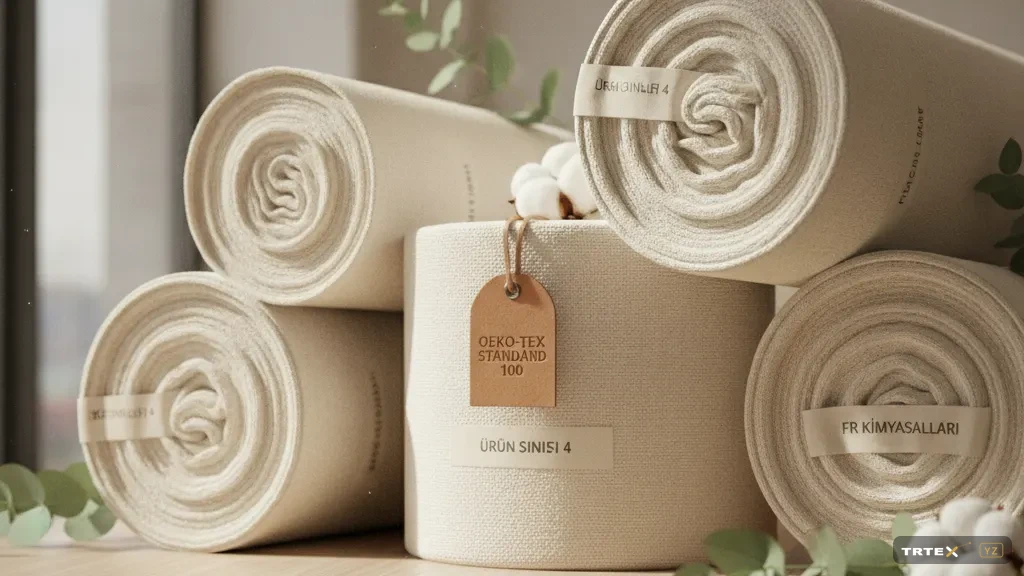
OEKO-TEX STANDARD 100 and Utilization Category IV Definition
OEKO-TEX STANDARD 100 is an independent certification system under which textiles from yarns to finished articles are tested for harmful substances [1], [6]. As explicitly articulated in the standard document, STANDARD 100 is not a certificate of quality or a general sustainability guarantee; it certifies that the article has been audited for chemical residues harmful to human health [1].The STANDARD 100 system divides articles into four distinct classes according to their level of contact with the consumer [1]. Decoration products such as curtains, table cloths, upholstery and wall coverings are certified under Product Class IV [1].
Evaluation of Flame Retardant Chemicals and Annex 5 Bans
The evaluation of flame retardant chemicals does not constitute a separate standard for Class IV, but is governed by uniform rules across all classes throughout STANDARD 100 [1], [3]. The flame retardant active product used must have been evaluated and accepted in advance by OEKO-TEX [1].The standard does not prohibit all halogenated or brominated compounds, but bans specific substances listed in Annex 5 [1], [3]. This list encompasses PBB, PBDE, HBCDD, TBBPA and TCEP [2], [3].
For chlorinated paraffins (SCCP and MCCP), a combined threshold value of 50 mg/kg is enforced [3]. Heavy metals are also restricted [1], [3]. Fabrics made of fibers with flame retardant properties can also obtain STANDARD 100 certification [1].
Certification Process, Audits and Verification Steps
Testing is conducted at authorized OEKO-TEX institutes such as Hohenstein [4]. Certificates issued upon testing remain valid for 1 year [1], [5]. Laboratory testing is repeated upon renewal [1], [5].OEKO-TEX criteria fulfill REACH requirements [6]. Validity of the certificate can be audited online via the OEKO-TEX verification portal using the QR code or certificate number on the label [6].
T
TRTex Editorial Team
Prepared with AI assistance · TRTex AI
This content was prepared with AI assistance (EU AI Act 2024/1689, Article 50). Information with a source is given with a link to that source; if you notice incorrect or missing information, please write to us via the contact page.
SOURCES & CITATIONS
- OEKO-TEX — STANDARD 100 Standart Belgesi (Edition 01.2026) (accessed: 2026-09-29) — oeko-tex.com ↗
- OEKO-TEX — 2026 Yeni Düzenlemeler ve Sınır Değerler (accessed: 2026-09-29) — oeko-tex.com ↗
- OEKO-TEX — Ek 4 ve Ek 5 Sınır Değerler (Edition 02.2025) (accessed: 2026-09-29) — oeko-tex.com ↗
- OEKO-TEX — Yetkili Enstitüler ve Ofisler (accessed: 2026-09-29) — oeko-tex.com ↗
- OEKO-TEX — STANDARD 100 Factsheet (accessed: 2026-09-29) — oeko-tex.com ↗
- OEKO-TEX — STANDARD 100 Portalı (accessed: 2026-09-29) — oeko-tex.com ↗