ITMF survey: capacity utilisation up to 71%, Europe at -36 points
In ITMF's 40th Global Textile Industry Survey, conducted on 21–29 September 2026, the global business situation improved to -23 points and capacity utilisation rose to 71%. Only South Asia (+13) and Africa (+9) are positive; Europe stands at -36 and East Asia at -20.
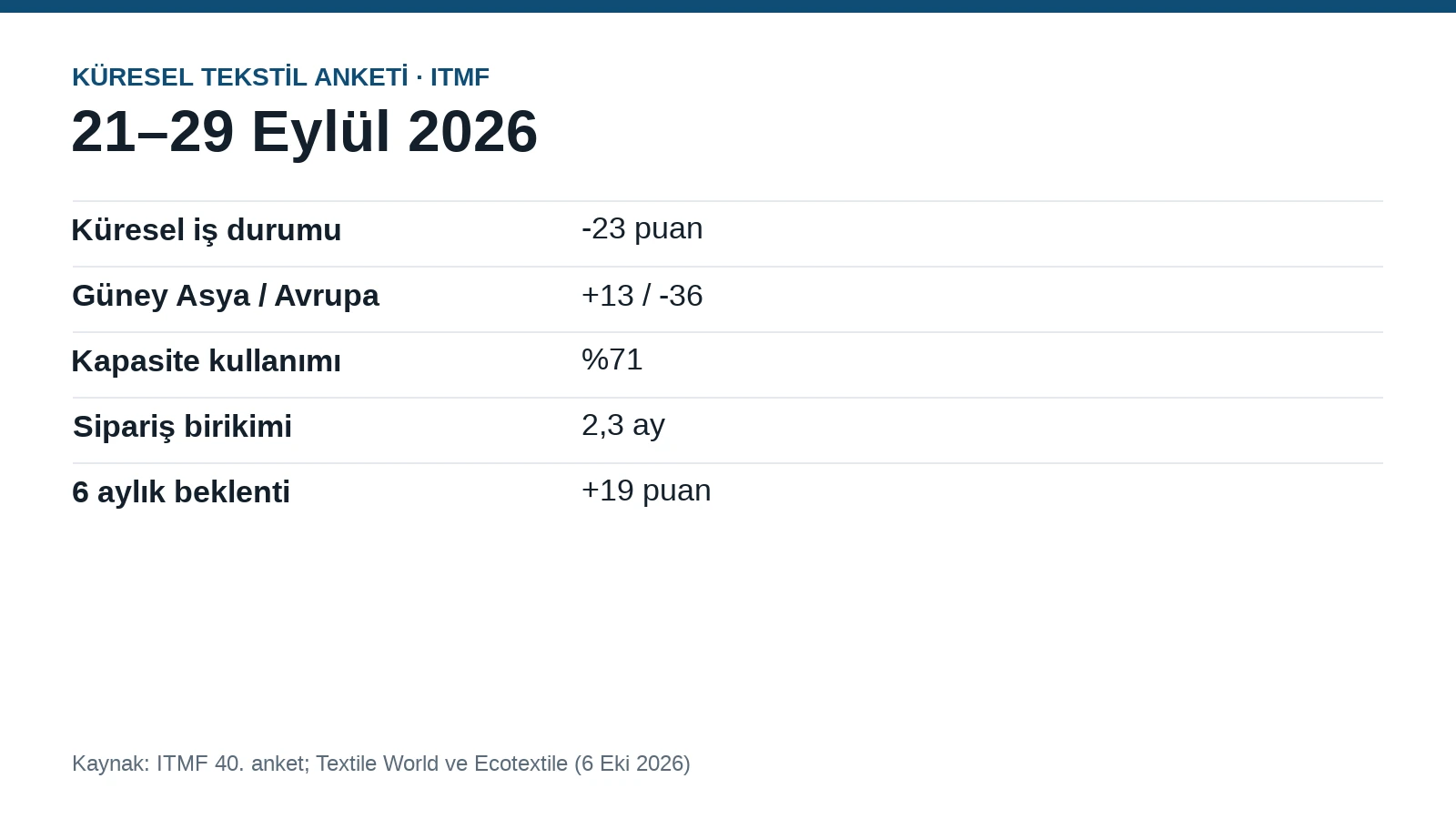
The International Textile Manufacturers Federation (ITMF) published the results of its 40th Global Textile Industry Survey on 6 October 2026. According to the survey, conducted on 21–29 September 2026, the global business situation improved slightly to -23 points, well above the November 2023 low of -46 points. Conditions nevertheless remain weak; ITMF describes them as "a new normal of high uncertainty".
Key analysis
- Regions: Only South Asia (+13) and Africa (+9) are positive. East Asia (-20) and Southeast Asia (-6) remain pessimistic; Europe (-36), South America (-44) and North & Central America (-56) report the weakest conditions.
- Value chain: Fibre producers (+17) are the only positive segment; spinners stand at -33 and finishers at -42. Textile machinery manufacturers (-35) suffer from companies' reluctance to invest.
- Orders: Order intake edged up to -24 points but remains weak; South America fell to a record low of -69. Order cancellations remain at around 2% on average. The global order backlog shortened to 2.3 months, within the 2–2.5 month range held since mid-2023.
- Capacity: Capacity utilisation rose to 71%, above the November 2023 record low of 68% but well below the levels above 80% seen before late 2022.
- Expectations and concerns: Expectations for the next six months improved to +19 points, but 46% of participants expect no change. Weak demand is the main concern (56%), followed by high raw material (42%) and energy prices (41%). Concern about geopolitics eased to 36% from 46% in July.
- Response to US tariffs: Companies are mainly diversifying into non-US markets (29%), investing in automation and efficiency (23%) or absorbing the higher costs (23%).
Why it matters
Curtains, upholstery fabrics, bed linen and towels all pass through the spinning, weaving and finishing stages that the survey measures. The survey shows finishing (-42) and spinning (-33) as the weakest links, and producers in Europe (-36) working in clearly tougher conditions than competitors in South Asia (+13). Capacity at 71% and an order backlog of 2.3 months mean spare capacity in many mills: buyers are in a strong position on lead times and prices. Rising concern about raw material and energy costs, however, limits how far prices can fall.
What members can do
- European buyers and importers: 71% capacity and a 2.3-month backlog leave room to ask for shorter lead times; discuss lead time and price together in spring 2027 orders.
- Curtain, upholstery and bed linen makers: concern about raw materials (42%) and energy (41%) has risen; shorten the validity of your quotes or add a raw-material-linked price clause.
- Exporters selling to the US: 29% of surveyed companies are turning to non-US markets; review your price list and trade fair calendar with stronger competition in Europe and other markets in mind.
Sources: Textile World, 6 October 2026 · Ecotextile News, 6 October 2026 · ITMF press releases
Background: our earlier coverage
- Innovation in Denizli Towel Manufacturing: New Standards in Rapid Drying and Softness
While preserving its legendary heritage of craftsmanship, Denizli towel manufacturers are engineering innovative finishing techniques that deliver rapid drying, enhanced absorbency, and enduring softness.
- Artificial Intelligence in the Textile Industry: Transformation from Design to Manufacturing
Artificial intelligence is revolutionizing the textile industry across design, production scheduling, quality assurance, and predictive trend analysis, elevating productivity and customized manufacturing.
- Profit Margin Squeeze for Yarn Spinners: Fiber Costs Challenge the Weaving Industry
Confronting margin compression driven by cotton commodity spikes and hyper-competitive market dynamics, yarn manufacturers are pivoting toward fiber blends to safeguard profitability.