ACADEMY ARTICLE
Comparison of Inherent FR and Chemical Finish Durability
T
Author: TRTex Editorial Team
Published: 22 June 2026 · Last reviewed: 29 September 2026 · ⏱️ 2 min read
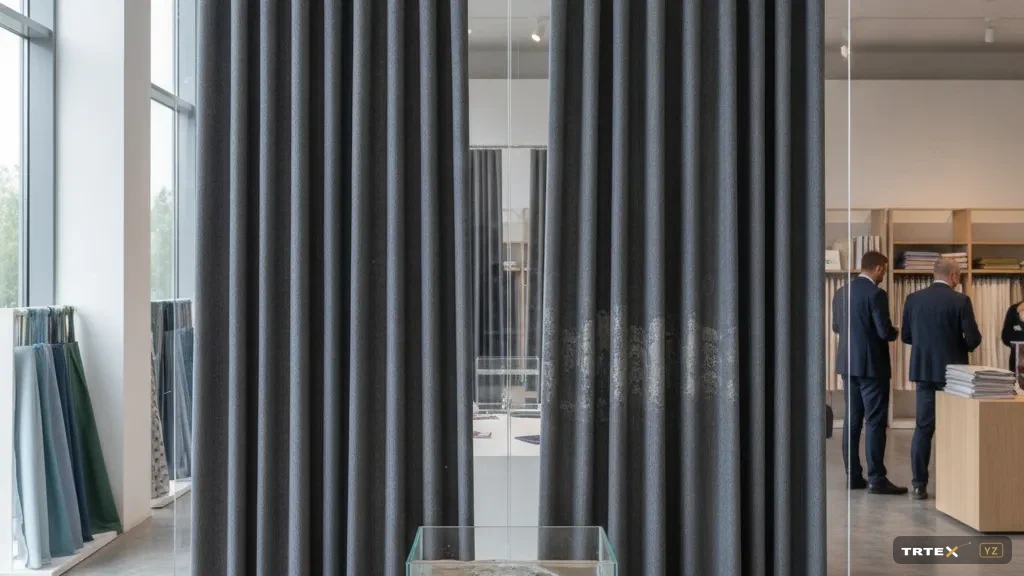
Concepts of Inherent Flame Retardancy and Chemical Finish
Fire safety in contract textiles is ensured through technologies that retard the ignition behavior of fabric exposed to flame [1], [2].In this field, there are two primary approaches: 'Inherent FR' (inherently flame retardant) and 'chemical finish' [2], [3].
In inherent FR technology, flame retardancy is integrated at the molecular level into the polymer backbone during chemical polymerization or spinning stages [2], [3].
In phosphorus-modified polyester fibers (for example Trevira CS), which are among the most common representatives of this group, flame-retardant organic phosphorus monomers are bound to the polymer chain via covalent bonds [1], [3].
Kanecaron is also an inherent FR fiber [2].
Chemical Finish Coatings and Differences in Laundering Durability
In the chemical finish method, the FR chemical is applied to the fabric subsequently [3].Because non-durable finishes can be removed by water, these fabrics may lose their FR properties upon laundering [1], [3].
In inherent fibers, by contrast, flame retardancy is an intrinsic property of the fiber structure [2], [3].
Industrial 50 Laundering and Healthcare Sector Specifications
The HTM 05-03 Part C fire safety guidance published by the UK National Health Service (NHS) serves as the primary reference for curtain and fabric selection across healthcare campuses [1].The NHS guide recommends the BS 5867-2 Type B standard as the baseline performance tier for curtains deployed in hospitals and clinics [1].
Contrary to popular industry assumption, the 50-wash requirement is not mandatory across all hospital premises; Type C performance tested after 50 industrial washes is recommended solely for high-risk specialized zones [1].
Because hospital textiles are laundered at high temperatures, the FR performance of fabrics used in these settings must be durable to laundering [1].
T
TRTex Editorial Team
Prepared with AI assistance · TRTex AI
This content was prepared with AI assistance (EU AI Act 2024/1689, Article 50). Information with a source is given with a link to that source; if you notice incorrect or missing information, please write to us via the contact page.
SOURCES & CITATIONS
- NHS England — HTM 05-03 Part C (accessed: 2026-09-29) — england.nhs.uk ↗
- KANEKA Corporation (accessed: 2026-09-29) — modacrylic.com ↗
- Polymers (MDPI) (accessed: 2026-09-29) — mdpi.com ↗
- IMO — Resolution MSC.307(88), 2010 FTP Code (accessed: 2026-09-29) — wwwcdn.imo.org ↗
- IMO — Resolution MSC.307(88), 2010 FTP Code (accessed: 2026-09-29) — wwwcdn.imo.org ↗