ACADEMY ARTICLE
Country-Based Fire Standards: Germany, France and Russia
T
Author: TRTex Editorial Team
Published: 22 June 2026 · Last reviewed: 29 September 2026 · ⏱️ 2 min read
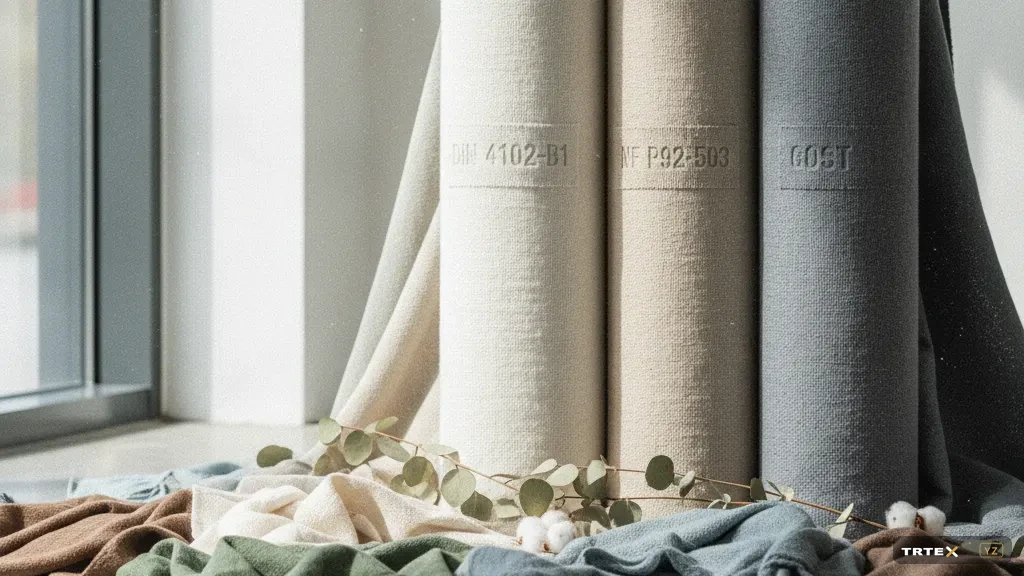
German Market: DIN 4102-1 and MVV TB Equivalence Principles
The fire performance of curtains and interior decoration materials deployed across the German contract textile market is traditionally governed by the DIN 4102-1 specification and regional state building regulations [1], [2]. Under the DIN 4102-1 standard, class B1 designates 'hardly inflammable' (schwerentflammbar) materials, whereas class B2 designates 'normally inflammable' products [1], [2]. Pursuant to the assembly place regulations (Muster-Versammlungsstättenverordnung - MVStättVO § 33) enacted by German federal states, stage curtains and decorative materials in assembly halls must be at least 'hardly inflammable' [2].However, the Model Administrative Provisions on Technical Building Rules (MVV TB Anhang 4) published by the Conference of German Building Ministers explicitly states that this requirement can be verified via the harmonized European standard EN 13501-1 (such as class C-s2,d0) [1]. Consequently, an applicable EU standard classification is recognized in place of a regional DIN test certificate [1]. For testing apparatus, the 'Brandschacht' test rig is utilized under DIN 4102-15 and DIN 4102-16 [1].
French Market: NF P92-503 Electric Burner Test and M Classes
In France, M classification may be sought in public-access buildings (ERP) [5].NF P92-503 represents the French national fire standard for flexible materials [4].
Russian Federation: Federal Law 123-FZ and Textile Classification
The fire safety of curtain and textile products exported to the Russian Federation market is governed by Federal Law No. 123-FZ on Technical Fire Safety Regulations [6]. Although it is widely stated across the sector that GOST 30244 is required for curtains in commercial buildings, this stems from technical confusion [6].Pursuant to Article 13 of Federal Law 123-FZ, the GOST 30244 standard determines the combustibility (горючесть) classes of building materials (Г1 low flammability, Г2 moderate, Г3 normal, Г4 highly flammable) [6], [7]. Textile and leather materials are regulated in a distinct paragraph separate from building materials and are classified according to ignitability (воспламеняемость) characteristics [6]. Under the statute, textiles are divided into two main categories: 'easily ignitable' (легковоспламеняемые) and 'hardly ignitable' (трудновоспламеняемые) [6]. While the GOST 30244 test chamber measures flue gas temperature and mass loss, textile-specific ignitability criteria govern curtain exports [6], [7].
T
TRTex Editorial Team
Prepared with AI assistance · TRTex AI
This content was prepared with AI assistance (EU AI Act 2024/1689, Article 50). Information with a source is given with a link to that source; if you notice incorrect or missing information, please write to us via the contact page.
SOURCES & CITATIONS
- DIBt / Bauministerkonferenz — MVV TB Ausgabe 2019/1 (accessed: 2026-09-29) — is-argebau.de ↗
- Bauministerkonferenz — Muster-Versammlungsstättenverordnung (MVStättVO) (accessed: 2026-09-29) — is-argebau.de ↗
- DIN Media — DIN 4102-16 (Brandschacht) (accessed: 2026-09-29) — dinmedia.de ↗
- AFNOR Editions — NF P92-503 (accessed: 2026-09-29) — boutique.afnor.org ↗
- AFNOR Editions — NF P92-507 (M Sınıflandırması) (accessed: 2026-09-29) — boutique.afnor.org ↗
- Rusya Federasyonu — 123-FZ Federal Kanunu (Madde 13) (accessed: 2026-09-29) — base.garant.ru ↗
- GOST 30244-94 Metni (Garant) (accessed: 2026-09-29) — base.garant.ru ↗
- DIN Media — DIN 4102-1:1998-05 (accessed: 2026-09-29) — dinmedia.de ↗