Profit Margin Squeeze for Yarn Spinners: Fiber Costs Challenge the Weaving Industry
Confronting margin compression driven by cotton commodity spikes and hyper-competitive market dynamics, yarn manufacturers are pivoting toward fiber blends to safeguard profitability.
Raw Material Volatility Pressures the Supply Chain from Top to Bottom
The spinning and weaving sectors have landed squarely in the crosshairs of severe gyrations across global commodity exchanges. Rapid price appreciation in cotton futures has triggered an escalating wave of cost pressure, beginning upstream with raw fiber procurement, moving into spinning mills, and extending down to finished fabric weaving operations. The most acute dimension of this squeeze lies in the severe difficulty manufacturers encounter when attempting to pass heightened input costs onto downstream customers: Multi-quarter procurement agreements and hyper-competitive market structures sharply curb price passthrough agility.
While cotton retains its status as the most ubiquitously utilized natural textile fiber globally, its benchmark valuation is dictated by fluctuating climatic events, acreage allocations, and trade protection policies across cornerstone producing giants—principally the United States, India, China, and Brazil. This multivariate volatility compromises price predictability, rendering inventory hedging and stock preservation increasingly precarious for spinning mills.
Fundamental Transformation in Fiber Blending Recipes
The textile sector's most immediate and pervasive response against escalating raw material burdens has been a strategic reformulation of blending recipes. Commercial demand for cotton-viscose and regenerated polyester hybrid yarns expanded by 40%, whereas pure virgin cotton fabrics command an pronounced price premium across global exchanges. These twin market forces reinforce one another: Accelerating migration toward blended spun yarns accentuates the relative scarcity of all-cotton woven goods, cementing their market position as premium luxury commodities.
Regenerated cellulosic fibers, including modal and viscose, mirror cotton's moisture regulation, handfeel, and breathability while delivering markedly stabilized pricing trajectories. Simultaneously, recycled polyester (rPET) is cementing its appeal both as a cost buffer and a verified sustainability credential. For export-geared mills shipping into European territories, rPET yarn blends carry decisive commercial value under Environmental Product Declaration (EPD) mandates.
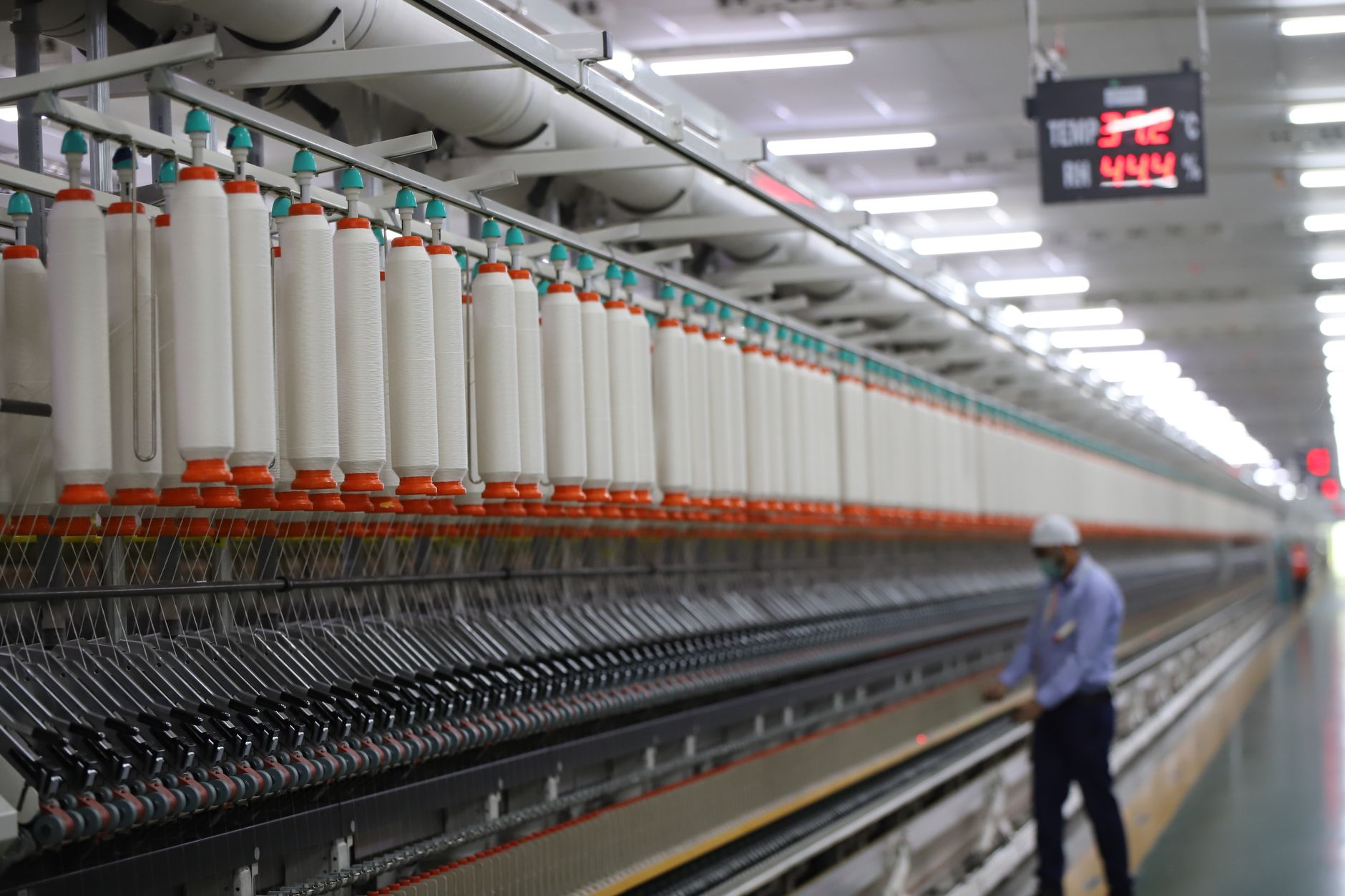 *Visual: RAJESH KUMAR VERMA (Pexels) — Blended fibers and yarn cones in an industrial weaving facility*
Vertically Integrated Mills Secure Decisive Competitive Advantages
Industry analysts emphasize that market participants best positioned to weather this margin squeeze are vertically integrated facilities encompassing fiber ginning, yarn spinning, twisting, weaving, and wet finishing under a unified operational umbrella. Integrated mills leverage the distinct capacity to balance cost fluctuations across consecutive production stages, utilize buffer storage inventories with superior flexibility, and wield commanding purchasing leverage. Conversely, specialized operations restricted strictly to yarn twisting or isolated greige weaving occupy a vastly more vulnerable posture.
For small and medium-sized enterprises (SMEs), raw material purchasing consortiums and centralized bourses emerge as transformative structural avenues capable of providing volume discounts beyond individual negotiation leverage. While selected regional clusters in Europe and Asia have executed this cooperative model with success, broader deployment across Turkey's textile ecosystem remains an emerging opportunity.

Market Dynamics and Strategic Price Governance
The strategic deployment of exchange-traded commodity futures has evolved into a standard risk mitigation mechanism among tier-one producers. Hedging strategies built on cotton derivative contracts are increasingly embedded into corporate financial management among export-centric operations. Nevertheless, accessing structured financial hedges continues to pose structural friction for small-scale operators due to capital adequacy and technical risk thresholds.
On the fabric weaving front, negotiating bilateral price adjustment clauses and commodity-indexed variable pricing frameworks represents the primary defense against margin erosion. Contractual mechanisms of this nature have gained significant traction among Turkish textile exporters sustaining multi-year supply partnerships with European retail distributors.
Strategic Windows for B2B Industry Stakeholders
The prevailing industrial conjuncture presents a duality of structural risks and actionable commercial openings across the textile value chain. For yarn producers, developing proprietary blending competencies and positioning technical hybrid yarns within the premium category provides the clearest roadmap to offset margin contraction. For weaving mills, securing multi-source supplier agreements for alternative cellulosic fibers fortifies structural resilience against commodity price swings.
For downstream home textile brands and commercial retail buyers, this transitional period offers a strategic window to diversify their supplier portfolios and cement long-term procurement alliances. Designing transparent cost-sharing mechanisms alongside raw-material-stressed manufacturers reinforces both supply continuity and long-term pricing equilibrium.